
Send Browser Notifications from a Website (Notifications API)
Many web applications use browser push notifications to notify their users. These notifications are sent to user devices even when the browser window is open. In this post, we will implement this push notification to be sent every five minutes.
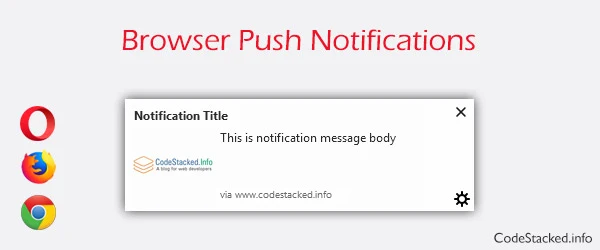
The Notifications API allows websites to display desktop notifications to end users, even when the page is not active. These notifications can also be sent when the browser window is closed, when used with Service Workers and Push API.
Difference Between Web Push and Notifications API
The Web Push/Push API allows servers to send messages to user devices, although the user is not on site. The Notifications API displays local messages to website visitors. The API can send browser notifications if the browser window is in the background, but not if the browser is closed. Web Push can notify users even when the browser is closed.
How to Implement Browser Notifications Using Notifications API?
The notifications API works in a secure context in most or some browsers, even if you are working in a local environment. This API is supported by all major browsers. How desktop notifications are displayed can vary from browser to browser and operating system. This post will explain in simple steps how to send browser notifications. We will be using the Notifications interface of this API. For this post, we will create the following files:
- index.html: Contains the main web page elements that will initiate notifications.
- javascript.js: It will check if the browser supports notifications, then trigger website notifications at a specific interval.
- style.css: Contains document styles.
Create a Button to Send a Browser Notification
Create an HTML page with a button to send desktop notifications from a website using the JavaScript notifications API.
index.html
<!DOCTYPE html>
<html>
<head>
<title>Send Browser Notification from Website - Demo</title>
<meta content="text/html; charset=UTF-8" http-equiv="Content-Type"/>
<meta content="width=device-width, initial-scale=1, maximum-scale=1" name="viewport" />
<link rel="stylesheet" href="css/style.css" />
<script src="js/javascript.js" type="text/javascript"></script>
</head>
<body>
<section class="section py-4">
<div class="container">
<div>
<button type="button" class="btn btn-green show-notification">Show Notification</button>
</div>
<div class="popup hidden">
<span class="close" data-dismiss="popup">×</span>
Your browser does not support notifications
</div>
</div>
</section>
</body>
</html>
Send Browser Notifications with JavaScript Notification API
init_notification() and send_notification(). The init_notification
will be triggered when the document is loaded, or for demo purposes, when the show
notification button is clicked. This function will check if the browser
supports notifications; it will request permission to show
notifications. Otherwise, it will show a pop-up to the user, notifying them that the
browser does not support notifications.
The send_notification
will show the notification every five minutes. It checks if
notification permission was granted or not. If the user had allowed browser
notifications to be displayed, it would send the browser notification
using the static notification object we created.
javascript.js
let notification_object = {
    url: "https://www.codestacked.info",
    title:"Notification Title",
    options: {
        icon: "https://assets.codestacked.info/images/codestacked-logo.png",
        body: "This is notification body"
    }
}

document.addEventListener("DOMContentLoaded",function(){
    init_notification();

    document.querySelector("[data-dismiss=popup]").addEventListener("click", function(){
        this.parentElement.classList.add("hidden");
    });

    document.querySelector(".show-notification").addEventListener("click", function(){
        init_notification();
    });
});

function init_notification(){
    if("Notification" in window){
        // If notification permission is granted then send notification
        if (Notification.permission === "granted") {
            send_notification(notification_object);
        }
        // If notification permission is not denied then request for permission
        else if(Notification.permission !== "denied"){
            Notification.requestPermission().then((permission) => {
                if (permission === "granted") {
                    send_notification(notification_object);
                }
            });
        }
    }
    else{
        document.querySelector(".popup").classList.remove("hidden");
    }
}

function send_notification(notification_object){
    if(Notification.permission === "granted") {
        let notification = new Notification(notification_object.title, notification_object.options);
        notification.onclick = function(){
            window.location.assign(notification_object.url);
        }
    }
}

// Send out notification every five minutes
window.setInterval(function(){
    send_notification(notification_object);
}, (60000 * 5));
Add CSS Styles for HTML Interface
Add CSS styles for the entire web page and pop-up notification.
style.css
* {
    box-sizing: border-box;
}
html,body {
    margin: 0;
    padding: 0;
}
body {
    background-color: #f6f6f6;
    font-family: "Segoe UI", "Roboto", "Helvetica", sans-serif;
    font-size: 15px;
    font-weight: normal;
    font-style: normal;
}
a {
    text-decoration: none;
    color: #3778cd;
}
.py-4 {
    padding-top: 1rem;
    padding-bottom: 1rem;
}
.container {
    max-width: 1140px;
    width: 100%;
    margin-right: auto;
    margin-left: auto;
    padding-right: 15px;
    padding-left: 15px;
}
.btn {
    display: inline-block;
    padding: 5px 10px;
    cursor: pointer;
    font: inherit;
    border-radius: .25rem;
}
.btn-green {
    background: #009549;
    border: 1px solid #009549;
    color: #fff;
}
.popup {
    max-width: 300px;
    background: #e65442;
    color: #fff;
    padding: 10px;
    position: fixed;
    inset: auto 0 10px 0;
    margin: 0 auto;
    text-align: center;
    animation: moveUp .5s;
}
span.close {
    font-size: 20px;
    line-height: 20px;
    cursor: pointer;
}
.hidden {
    display: none;
}
@keyframes moveUp {
    from {
        bottom: -50%;
    }
    to {
        bottom: 10px;
    }
}